

Sous Chef.
A meal-planning app built from a love of cooking, and a place to put marketing engineering to work.
It started with wanting to cook.
Bryce started Sous Chef because he loved cooking, but wanted the burden of meal planning off his plate. He wanted to explore new cuisines, wanted the family to eat locally, and didn’t want a fridge full of half-used ingredients at the end of the week.
Meal kits handled a lot of the mental gymnastics, but he wanted more variety and the freedom to use what looked good at the farmers market. That led to a planner built around the household, its preferences and the schedule for the week.
Sous Chef also gave him somewhere to test marketing engineering. Building, editing, outreach and automation could all be done more easily and efficiently than before, but it was hard to tell what was real alpha versus gaslighting from the sidelines. With Sous Chef, he could test tools, strategies and workflows safely.


Five dinners. One trip to the market.
— and zero meal kits.A meal planner that remembered the household.
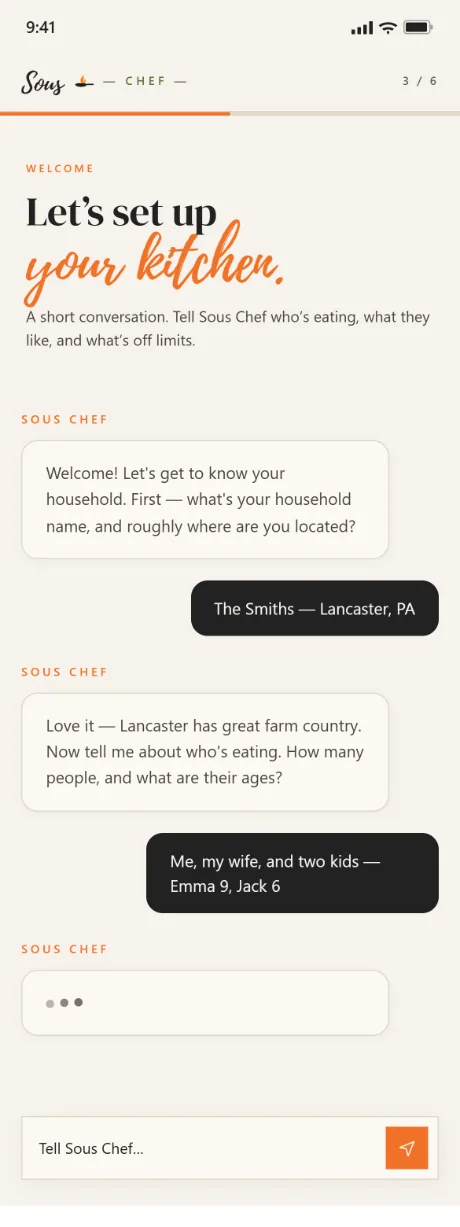
Bryce had already been using AI to plan dinners. Each week, he fed it more context: what his wife liked, what the kids would eat, meals they’d already made and ingredients they had on hand. It could suggest good meals, but it kept forgetting things he’d explained before. Even the detail that black pepper was too spicy for his wife had to be repeated.
He started wondering whether he could build something that kept that context. Household preferences would be stored permanently, meal recommendations would account for the week ahead, and grocery lists would come from the recipes. Reusing ingredients across meals could also help keep half-used produce from piling up in the fridge.
Building it meant learning Claude Code, APIs, agentic workflows and database structure, then working through the design with Higgsfield and Claude Design. He fitted the work around his job and family life, sometimes with a couple of hours on a weekend and sometimes with five minutes at the end of the day.
When he shared Sous Chef with friends and family, other households recognized the same problem. They started making plans, cooking the recipes and sending feedback. There were bugs to work through, but hearing that someone had found a meal they loved gave him a reason to keep improving it.
- 01Household contextPreferences and the week ahead.
- 02RecipesThe agreed meals and their ingredients.
- 03Grocery listBuilt from those exact recipes.
- 04ReviewCheck the list against the meals.
Codex helped build the creator research.
With the app built, it was time to see whether marketing engineering could help find out if anyone cared. Food and family creators were a natural audience to explore first. Research meant finding people whose content aligned with Sous Chef, looking at what they actually posted, and hunting for a reason to start a conversation.
Bryce used Codex to build a TikTok creator-research and personalized-outreach system. It identifies niche creators, collects profile and post context, and uses that material to prepare a more specific outreach draft. All content is centralized in Airtable, and drafts are pushed directly to the Gmail drafts folder for review before sending.
In the first week, Bryce had a 12% response rate, with creators making Sous Chef accounts and exploring the product.
- 01FindIdentify food and family creators.
- 02ReadCollect relevant bio and post context.
- 03DraftPrepare a specific introduction.
- 04ReviewDecide whether the fit and message earn an approach.
A short film tested the creative process.
Bryce developed a Sous Chef launch video from an animation reference and a storyboard. He used AI tools to make the first cut, then revised the scenes where the motion, characters or creative direction missed the mark. The finished piece showed how far the tools could take an idea, and where human taste still shaped the result.
Adding automated video into the social calendar.
The video experiments became a Plan → Prep → Plate format: a recipe card, ingredients appearing on the cutting board, then the finished dish.
Asking a video model to preserve the kitchen and invent every movement at once introduced unwanted changes. The prep sequence moved to individually generated, reviewed still states assembled with hard cuts. That made each ingredient placement and change easier to inspect.
The reviewed manual video path and the recurring still-image workflow remain separate. The weekly reminder starts the work; generation, review and publishing still have explicit human steps.
What carries into client work.
Give each step a dependable input.
Recipes feed the grocery list. The meal plan feeds the content brief. Creator context feeds the outreach draft.
Carry creative judgment into the process.
A rejected image should change the shot instructions or review check, so the next run can use the correction.
Check what happens after the output.
A generated plan still needs to work for the household. A drafted message still needs a fit decision. A finished carousel still needs review.
These are the systems and lessons from the work so far. Each new run gives us another chance to see what holds up and what needs to change.
What could your team put to work?
Explore a defined build your team can run, or bring us in to operate and improve an agreed part of marketing.
The meal plan became the content brief.
The next channel to sort out was social media. Bryce was making great-looking food, and he and his wife were working on capturing photos of each dish for Instagram and TikTok. But a 20–40 minute photoshoot before dinner each night was leading to cold dinners.
Bryce was determined to use AI image and video generation and get back to enjoying hot food. Sous Chef already had the raw material for a week of content. The actual meal plan, its recipes and plating instructions turned out to be ideal foundations for generation briefs. Bryce built a reusable workflow connecting the plan to visual direction, image generation, review, captions and publishing drafts.
Codex coordinates the workflow. Higgsfield generates the food imagery using selected kitchen and place-setting references. Each image gets checked for recipe accuracy, believable proportions, consistency of the setting and enough variety to make the carousel worth looking through.
The first images were too repetitive. Bryce changed the direction to include different crops, angles, plates and table settings. Those corrections became instructions and checks for the next run.
Once the images are selected, the workflow prepares Instagram and TikTok captions and assembles the carousel. Exact caption approval comes before the Buffer draft handoff. Bryce reviews the drafts and decides when to schedule or publish.